August 2026 Market Wrap


Table of Contents
August 2026 Market Wrap
9 Sep 2026


The AI trade came back, and the bond market spent the month trying to take it away
August was the month the AI trade got its confidence back. Software rallied 16%, Korea went from a historic crash to a bull market in ten trading days, bitcoin had its best month since November 2024, and government bond yields in the UK, France, Canada, Germany and Japan all hit five-year highs at the same time. It’s amazing what a couple of strong results can do for sentiment.
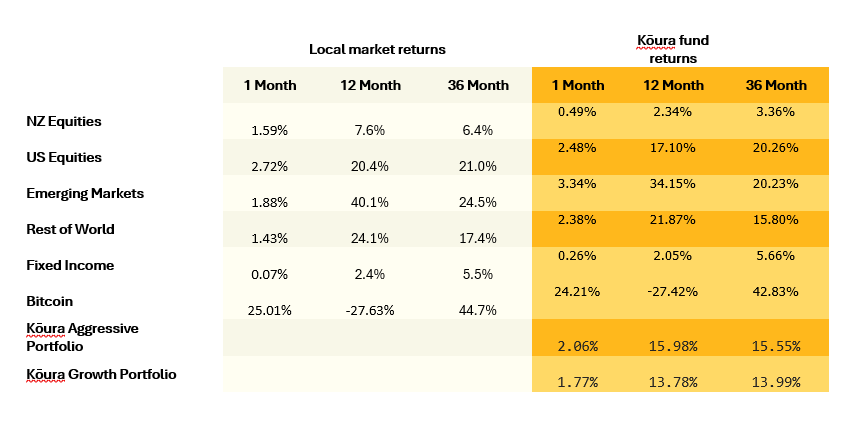 *Source: Factset: Kōura returns are pre-tax and post-fees. Returns over 12 months are annualised. Local market returns use the relevant markets indices; NZ Equities uses NZX50 index; US Equities uses S&P500 index; Rest of World uses MSCI EAFE Index; Emerging Markets uses MSCI Emerging Markets Index, Fixed Interest uses Bloomberg Aggregate NZ Composite Bond Index. Bitcoin return is the USD change in price of Bitcoin. The return for an Aggressive Portfolio represents the equivalent of 95% growth and 5% income assets investing in core Kōura Funds. The return for a Growth Portfolio represents the equivalent of 80% growth and 20% income assets by investing in core Kōura Funds. Returns are calculated by Kōura. Past performance is not a reliable indicator of future performance. Returns are not guaranteed, and investment values may fluctuate over time.
AI bounces back
The S&P 500 rose 2.7% in August, and technology shares — up 6.25% — produced more than three-quarters of that. But look one level down and the composition has changed completely. Software rebounded 16% over the month.
In late-July results from Microsoft, Amazon and Meta settled the argument about whether data-centre spending produces revenue. All three announced strong revenue growth, particularly in the cloud services businesses all driven by AI. Concerns remain around whether the market can generate the estimated US$2.5trillion to justify the level of capex being spent on AI, but confidence continues to grow
Korea went from a historic crash to a bull market in ten trading days
Interest rates are becoming the main part of the story
The US 10-year Treasury yield went from 4.68% mid-month to 4.73% on 28 August and pushed above 4.75% on the final day, it's highest since January 2025, as climbing oil prices firmed up expectations that the Fed's next move is a hike.
Confirming investors' worst fears, Kevin Warsh (the new US Federal Reserve Chair) said that he was impressed with the growth and disappointed that inflation is not slowing – basically leading investors to bank a rate rise as a sure thing.
Higher interest rates typically slow economic growth and impact markets – hence why Donald Trump and his treasury secretary are doing everything in their power to talk down long term interest rates. During the month, the US Government intervened in the bond market purchasing longer term bonds in an attempt to push down interest rates.
Higher interest rates are turning into a global story with interest rates hitting 5-year highs in UK, France, Canada, Germany and Japan. On 19 August the US Treasury doubled its buybacks of long-dated bonds, and yields fell — one arm of government stepping visibly into its own market.
New Zealand's labour market casts doubt on the NZ recovery
Unemployment rose to 5.6% in the June quarter from 5.4%, the highest in more than a decade, with 166,500 people out of work. The broader underutilisation measure — which counts the unemployed plus people who want more hours — jumped to 13.8% from 12.9%. Annual wage growth was 2%, against inflation of 4.1%, so the average worker is going backwards in real terms.
Paradoxically business confidence surveys remained strong though households still say it is a bad time to buy anything big. Despite this economic weakness, the market expects the RBNZ to continue hiking over the next few months to deliver on their inflation mandate. Interestingly, S&P economists have publicly come out stating that the sole mandate for the RBNZ (they are allowed to only think about inflation) will lead to higher interest rates in the medium term.
The NZX put together a fourth straight winning month, but it still has five years to make up
The NZX 50 rose 1.6% in August to finish at 13,917.30, with the final session unusually heavy as index funds rebalanced for MSCI's reweighting. Gentrack was the standout, up around 31% — remarkable for a company that lost a third of its value in a single day in May after cutting its earnings outlook. Fisher & Paykel Healthcare had its best month in two years, and Spark rose about 20%.
The long-run context matters more than any month: the local benchmark has returned 0.7% a year over five years, and our fund (0.3%) a year over the same timeframe. New Zealand shares are a small slice of our portfolios for exactly that reason.
The institutional money came back to bitcoin — and that was the whole story
In July I said I wouldn't read much into bitcoin's bounce because the institutional money still wasn't back. In August it came back, hard. US spot bitcoin ETFs took in US$3.52 billion of net new money, their best month of 2026 and roughly twenty times July's total, with inflows on 16 of 21 trading days including nine consecutive sessions.
Bitcoin rose about 25%, its strongest month since November 2024. One good month of flows does not make bitcoin a different asset — what matters is whether those flows are still there in three months.
Disclaimers:
*Bitcoin is highly volatile and not suitable for all investors. Before investing part of your KiwiSaver balance in the Kōura Bitcoin Fund, ensure you fully understand the risks associated with cryptocurrencies: https://shorturl.at/U6Mkp, and/or consider seeking financial advice.
*The views and opinions expressed in this article are those of Rupert Carlyon. This content is for informational purposes and should not be considered financial advice. Before making any financial decisions, consider consulting a financial adviser.
*Kōura Wealth Limited is the issuer and manager of the Kōura KiwiSaver Scheme. A copy of the Product Disclosure Statement is available at kourawealth.co.nz/pds
*Past performance is not a reliable indicator of future performance. Returns are not guaranteed, and investment values may fluctuate over time.