July 2026 Market Wrap


Table of Contents
July 2026 Market Wrap
6 Aug 2026


The return of uncertainty
July was all over the place and had four seasons in one month. We saw a return to war in the Middle East, AI uncertainty, AI recovery and fears of runaway inflation. A fascinating month to be an investor and it really reiterates our stance of “stay the course”, because you never know what is coming next.
Despite all the chaos, global markets finished the month only slighty down due to a last-minute rally in the S&P500 (almost entirely driven by Microsoft).
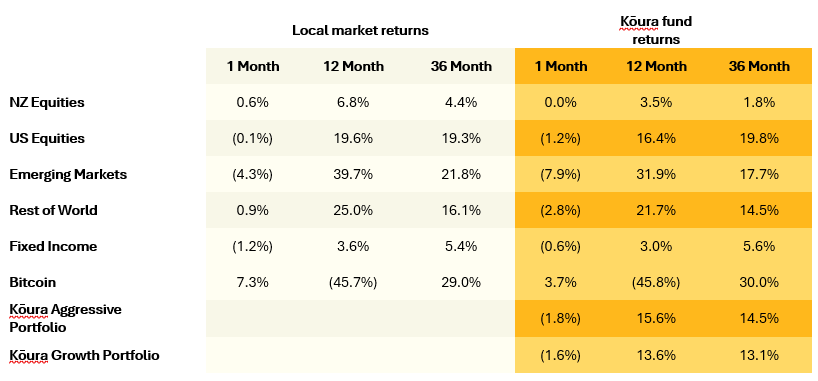
*Source: Factset: Kōura returns are pre-tax and post-fees. Returns over 12 months are annualised. Local market returns use the relevant markets indices; NZ Equities uses NZX50 index; US Equities uses S&P500 index; Rest of World uses MSCI EAFE Index; Emerging Markets uses MSCI Emerging Markets Index, Fixed Interest uses Bloomberg Aggregate NZ Composite Bond Index. Bitcoin return is the USD change in price of Bitcoin. The return for an Aggressive Portfolio represents the equivalent of 95% growth and 5% income assets investing in core Kōura Funds. The return for a Growth Portfolio represents the equivalent of 80% growth and 20% income assets by investing in core Kōura Funds. Returns are calculated by Kōura. Past performance is not a reliable indicator of future performance. Returns are not guaranteed, and investment values may fluctuate over time.
1. Concerns mount on the AI trade
Investors are starting to worry that the AI investment trade is one big Ponzi scheme, a few negative headlines emerged:
- Nvidia has further invested in memory manufacturer SK Hynix and has also provided a $250billion lease guarantee to OpenAI. Nvidia has now invested (or provided support) over US$750 billion into customers. Concerns are mounting that Nvidia is simply giving customers money so that they can purchase more Nvidia chips
- Data centres spend is becoming otherworldly. The large tech companies are now expected to invest more than US$850 billion this year in data centres, with spending set to grow again next year. Investment numbers keep growing, and investors are becoming sceptical that they will be able to generate a return on this investment
- Reports are coming out that companies are giving up on AI as they are struggling to generate a payback on the investment.
Microsoft's earnings announcement on 29 July did a good job of allaying those fears demonstrating exceptional growth in their data centre earnings. Following the strong results the shares jumped 15.5% the next day – the largest single-day increase in market value in stock market history, adding roughly US$480 billion.
Fair to say markets remain jittery and uncertain on the AI story.
2. The Korean stock exchange is bouncing like Bitcoin
Korea has been the AI golden child doubling in value over the past 12 months and quickly growing to be the sixth largest stock market in the world. This is all off the back of two companies, Samsung and SK Hynix, which make memory chips required to go into the AI trade. By the way -this is one of the reasons for the strength of the Kōura Emerging Markets Fund over the past few years, somehow Korea is still classified as an emerging market.
Nervousness around AI, Chinese technological advances and a muted investment outlook from SK Hynix sent the market tumbling 18% in two days - the 10.8% fall on 28 July triggered circuit breakers, which halted trading on two consecutive days. Even so, the index finished July down 22% – its worst month since the global financial crisis – despite an 18% rebound on 31 July after Microsoft's blockbuster results.
Interestingly – Japan is not materially different suffering from the same whipsaw momentum given it has also turned into an AI hardware market.
Like Bitcoin – the Korean stock exchange suffers from low levels of liquidity, hype and leveraged ETFs have driven the volatility. One thing I would bet on is the volatility to continue.
3. Iran war returns driving up inflation expectation
On July 8th the US and Iran resumed their tit-for-tat strikes. The very fragile and badly defined ceasefire fell apart around disputes on who actually controls the Strait of Hormuz and an Iranian regime that is refusing to give up its nuclear ambitions. It looks as though Iran will become a consistent millstone around Trump’s neck with no clear or easy way out.
The unfortunate outcome of the resumed war is higher oil prices – oil jumped from a year low of $70 per barrel on 7 July to end the month close to $90 as concerns rise on the inability to get oil out of the Strait. This has driven broader inflation expectations as it increasingly looks as though we will be in the stop start mode for a long period of time.
The fear is that higher oil prices will drive higher inflation which will choke economic growth and longer-term earnings.
4. Trump’s man at the Federal Reserve delivers (for Trump)
Despite the above, newly appointed US Federal Reserve Chair Kevin Warsh refused to raise interest rates at the 28-29 July meeting, holding the federal funds rate at 3.50-3.75% on a 9-3 vote, with three regional Fed presidents dissenting in favour of a hike. Despite the US consistently remaining above its inflation target since 2021, the US Fed refuses to raise interest rates, and while the statement hinted at a possible hike in September, markets were given little clarity on what would actually trigger one.
In his very brief (and largely uninformative) summary, Kevin Warsh claimed that market based interest rates have already moved higher, removing the need for the US Federal Reserve to act, as well as casting doubt on the current inflation gauge preferred by the US Fed. Markets are interpreting this as a signal that the US Fed will allow inflation to drift higher.
5. US earnings growth remains exceptional
The S&P500 is part way through one of the best earnings seasons of all time. By the end of the month, 66% of the S&P500 had reported earnings, with average earnings growth of 47% compared to the prior year (or 29% when you strip out one off gains) the strongest set of earnings growth since Covid. 86% of reporters beat their earnings forecasts – comfortably above the five-year average of 78% – and 77% beat on revenue.
The strong earnings growth really emphasises the strength of the global economy, and the fact that the large technology companies in particular are able to monetise the growth.
Pleasingly with all this earnings growth, the market is starting to look cheap. The price to earnings ratio has fallen from 28x at the start of the year down to 22x, now back in line with its (arguably elevated) 5-year average.
6. Interest rates rise in New Zealand
The RBNZ announced a start to the hiking cycle on 8 July with a 0.25% rise in the OCR to 2.50% and the prospect of more to come. Inflation remains high and has been persistently above the 2% midpoint of the RBNZ's 1-3% target band, but economic growth is uncertain.
Anecdotal evidence suggests the recovery may be underway, but who really knows? If the recovery is real it will be a true miracle, and the first time New Zealand has managed an economic recovery without the support of rising property prices.
This places New Zealand in a very difficult position - we are (maybe) at the very start of an economic recovery yet interest rates are already needing to rise, which is likely to put a further handbrake on the economic recovery.
Disclaimers:
*The views and opinions expressed in this article are those of Rupert Carlyon. This content is for informational purposes and should not be considered financial advice. Before making any financial decisions, consider consulting a financial adviser.
*Kōura Wealth Limited is the issuer and manager of the Kōura KiwiSaver Scheme. A copy of the Product Disclosure Statement is available at kourawealth.co.nz/pds
*Past performance is not a reliable indicator of future performance. Returns are not guaranteed, and investment values may fluctuate over time.